FREE EU AI ACT CLASSIFICATION RECORD FOR EXCEL
Preserve the facts behind the risk classification.
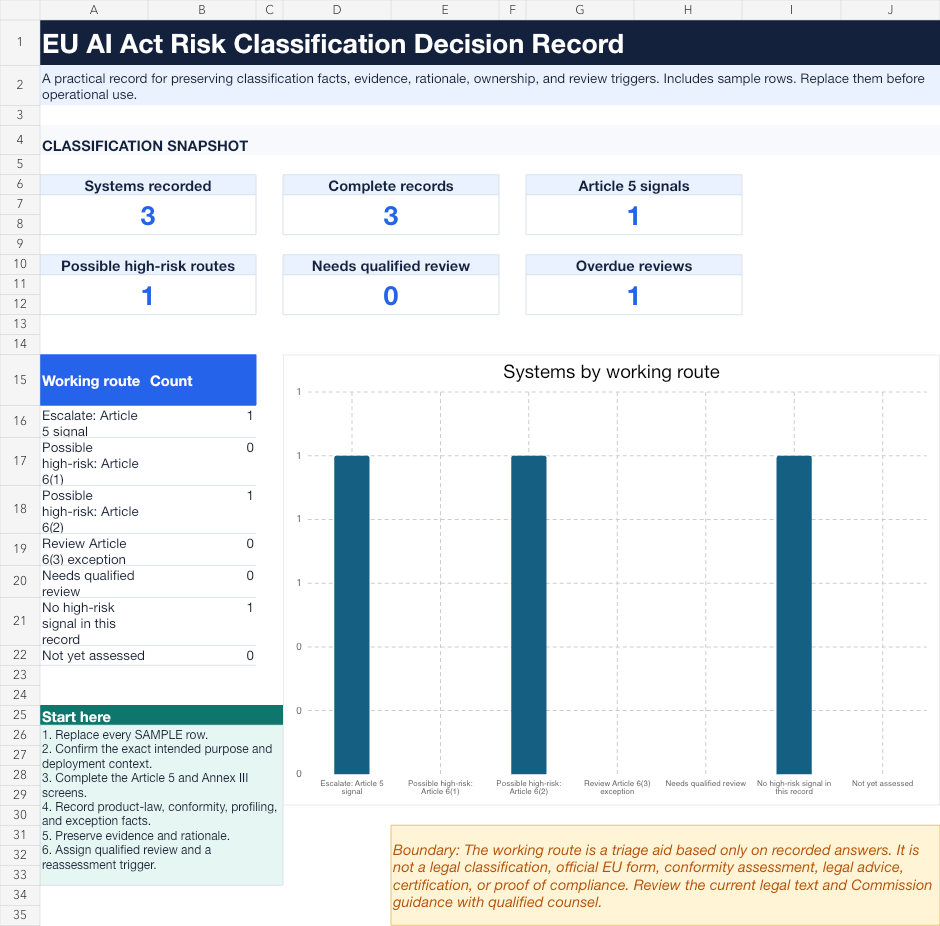
Download an editable XLSX for Article 5 screening, regulated-product and Annex III routes, Article 6(3) facts, profiling, evidence, rationale, ownership, decisions, and reassessment triggers. No signup, no email gate, and no upload.
- Editable XLSX
- Seven connected sheets
- Formula dashboard
- Sample records
- No signup
- No upload
WHY A DECISION RECORD
A risk label is not enough to explain the route.
The EU AI Act legal text uses different routes for prohibited practices, regulated products, and listed high-risk use cases. The European Commission has also published draft high-risk classification guidance. This workbook helps a team preserve the exact facts, evidence, reviewer, rationale, decision, and reassessment trigger while the current law and qualified advice control.
WHAT THE WORKBOOK TRACKS
Seven connected views from system scope to review history.
Decision dashboard
See system records, completed decisions, Article 5 signals, possible high-risk routes, qualified-review needs, overdue reviews, and route distribution.
System register
Define the provider or deployer role, intended purpose, affected people, sector, location, model, data, outputs, decisions, actions, owner, and material-change trigger.
Classification record
Preserve Article 5, Article 6(1), Article 6(2), Annex III, Article 6(3), profiling, evidence, reviewer, rationale, decision date, next review, and calculated route.
Article 5 screen
Ask specialist questions about potentially prohibited practices, record the answer and evidence, and escalate unclear or positive signals for qualified review.
Annex III map
Compare the exact intended purpose with specific listed use cases instead of relying on a broad area name alone.
Evidence and review
Index intended-purpose, workflow, human-review, vendor, legal, and change records while preserving the previous and updated route.
Guide and sources
Keep a practical review sequence, interpretation notes, important boundaries, and current official source links beside the working record.
A REVIEWABLE FIRST PASS
Start with the intended purpose, then document each route.
- 1
Define the exact system and context
Record what the system is intended to do, who provides or deploys it, who is affected, what data and outputs it uses, and whether it influences decisions or actions.
- 2
Screen Article 5 before continuing
Use the specialist questions to identify prohibited-practice signals. Treat a positive or unclear answer as an escalation, not a completed legal conclusion.
- 3
Test both Article 6 routes
Review the regulated-product route under Article 6(1) and map the exact Annex III listed use case for Article 6(2).
- 4
Preserve any Article 6(3) analysis
Record every required fact, the supporting evidence, the provider's rationale, and whether profiling of natural persons affects the route.
- 5
Assign a decision and reassessment trigger
Name the reviewer, decision owner, evidence location, decision date, next review, and events that require a fresh assessment.
IMPORTANT LIMITS
A calculated route is a triage aid, not a legal classification.
- The workbook does not decide whether the system is an AI system, whether an Article 5 practice applies, or whether a product or use case is high-risk.
- A broad Annex III area label cannot replace mapping the exact intended purpose to the specific listed use case.
- The Article 6(3) filter contains conditions and a documentation duty, and profiling of natural persons requires special treatment.
- The Commission's high-risk classification guidelines available in August 2026 are draft, not legally binding, and may change before final adoption.
- Confirm scope, classification, obligations, dates, exceptions, and evidence with current official sources and qualified counsel.
CONNECT CLASSIFICATION TO OPERATING GOVERNANCE
Link the route to inventory, risk, approvals, incidents, and policy.
The $19 AI Policy Operations Kit combines an AI inventory, 30 starter risks, approvals, incidents, a dashboard, and a scoring guide in one Excel governance workbook. It also includes five editable Word files, a PDF implementation guide, and lifetime BrandQuill Solo publishing.
$19 once
No subscription. Seven-day fit guarantee.See the complete kit →Download the full free starter kit →COMMON QUESTIONS
Document the reasoning without overstating the result.
What is included in the EU AI Act risk classification template?
The XLSX includes a dashboard, System Register, Classification Record, Article 5 Screen, Annex III Map, Evidence and Review log, Guide and Sources, sample records, validation menus, calculated routing flags, and official source links.
Does the workbook automatically decide the legal classification?
No. It records user-supplied facts and produces a working route for triage. It does not interpret every fact, make a legal determination, or replace review of the current law, guidance, system, intended purpose, deployment context, and evidence.
Which EU AI Act routes does it help document?
The record supports an Article 5 prohibited-practices screen, the Article 6(1) regulated-product route, the Article 6(2) Annex III route, the Article 6(3) filter and documentation questions, and the special treatment of profiling of natural persons.
Why does it include an Annex III map?
A broad label such as employment or biometrics is not enough. The map helps a reviewer compare the exact intended purpose with the specific listed use cases and preserve the answer, evidence, reviewer, and mapping note.
Is this an official EU template or legal advice?
No. BrandQuill created this original implementation aid. It is not an official EU form, legal advice, an automated legal classifier, a conformity assessment, certification, audit opinion, or proof of compliance.
Does BrandQuill require an account or upload the workbook?
No. The workbook downloads directly and can be edited locally. BrandQuill does not require an account or receive the facts, evidence, or conclusions entered in the file.
What does the $19 AI Policy Operations Kit add?
The paid kit connects AI inventory, 30 starter risks, approvals, incidents, a dashboard, and a scoring guide in one coordinated Excel workbook. It also includes five editable Word files, a PDF implementation guide, and lifetime BrandQuill Solo publishing.