FREE ARTICLE 4 AI LITERACY TRACKER FOR EXCEL
Turn AI literacy measures into reviewable evidence.
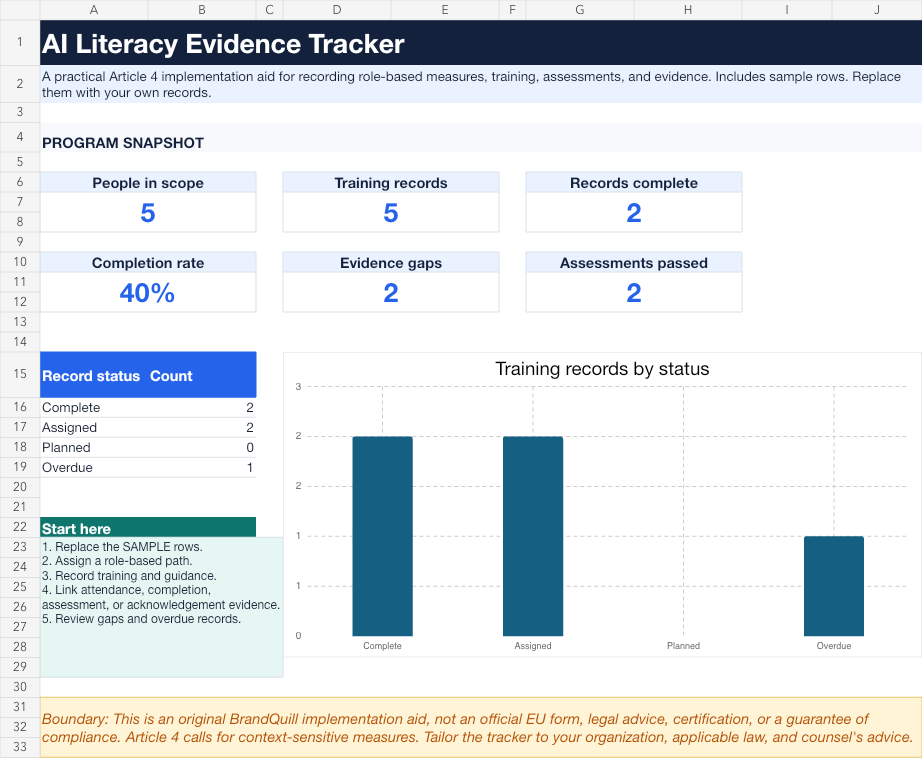
Download an editable XLSX for people and roles, role-based training paths, assigned and completed activities, assessment results, evidence references, owners, due dates, refreshers, and a formula-driven dashboard. No signup and no upload.
- Editable XLSX
- Six practical sheets
- Formula dashboard
- Sample records
- No signup
- No upload
THE CURRENT PRACTICAL DUTY
Use context-sensitive measures, then preserve what was actually done.
The European Commission's current AI literacy questions and answers states that the Article 4 obligation has applied since 2 February 2025. Providers and deployers should take measures supporting the development of AI literacy for staff and other persons dealing with AI systems on their behalf, considering knowledge, experience, education, training, use context, and affected persons or groups. The duty does not prescribe this workbook, one course, or one fixed score.
WHAT THE WORKBOOK TRACKS
Six connected views from role scope to evidence gaps.
Program dashboard
See people in scope, total records, completion rate, evidence gaps, passed assessments, overdue items, and status distribution.
People and roles
Record relationship, department, role, AI systems, use context, affected people, current knowledge, required depth, path, owner, and review date.
Training register
Track assignments, topics, delivery, owners, due dates, completion, score, pass mark, calculated result, evidence, record status, and refresher date.
Role matrix
Adapt six example role profiles covering general users, managers, recruiting, public content, technical work, and vendor review.
Evidence index
Index training materials, assignments, attendance, completion, assessments, acknowledgements, reviews, evidence locations, owners, and retention dates.
Guide and sources
Keep the practical workflow, evidence examples, important boundaries, and current official European Commission and EUR-Lex links beside the records.
A WORKABLE FIRST PASS
Start with one real role and one real AI use.
- 1
Define the people and context
Identify who operates or uses the AI system, what they do, what knowledge they already have, and which people or groups can be affected.
- 2
Assign proportionate measures
Choose content and depth for the role and exact use. A general drafting assistant and an applicant-screening workflow should not receive identical treatment.
- 3
Record delivery and results
Capture assignments, completion, assessment, questions, follow-up, accountable owners, and the evidence location instead of relying on memory or a calendar invite.
- 4
Review after change
Revisit measures after new systems, roles, data, affected groups, automation, incidents, failed controls, guidance, or other material changes.
IMPORTANT LIMITS
A filled register does not establish compliance or competence.
- The role profiles, topics, evidence examples, sample scores, and review cadences are editable BrandQuill starting points, not official EU requirements.
- Attendance alone does not prove understanding, and an assessment result does not prove safe conduct across every system or condition.
- Keep sensitive workforce or assessment information only where authorized and follow applicable privacy, employment, security, and retention rules.
- Confirm the current legal text, official guidance, organizational scope, sector rules, and qualified professional advice before relying on any record.
CONNECT LITERACY TO OPERATING GOVERNANCE
Link training evidence to inventory, risks, approvals, incidents, and policy.
The $19 AI Policy Operations Kit combines an AI inventory, 30 starter risks, approval log, incident log, dashboard, and scoring guide in one Excel governance workbook. It also includes five editable Word files, a PDF implementation guide, and lifetime BrandQuill Solo publishing.
$19 once
No subscription. Seven-day fit guarantee.See the complete kit →Download the full free starter kit →COMMON QUESTIONS
Document measures without overstating what a template can prove.
What is included in the free AI literacy training record template?
The XLSX includes a formula-driven dashboard, People and Roles register, Training Register, Role Matrix, Evidence Index, practical guidance, official source links, sample records, validation menus, due-date logic, and assessment formulas.
Is this an official EU template or proof of compliance?
No. BrandQuill created this original workbook as an implementation aid. It is not an official EU form, legal advice, certification, audit opinion, or proof of compliance.
Who should an organization consider for AI literacy measures?
The European Commission guidance describes staff and other persons who deal with the operation or use of AI systems on a provider or deployer's behalf. Scope and measures depend on the organization, systems, people, knowledge, experience, education, training, use context, and affected persons or groups.
Does Article 4 prescribe one curriculum or assessment?
No single curriculum, course, score, or workbook is prescribed by Article 4. Measures should be proportionate to the actual context. Use the role matrix and sample topics only as editable starting points.
What can I record as evidence?
Examples include dated training materials, assignment notices, attendance, completion records, assessment results, scenario exercises, policy acknowledgements, manager reviews, and documented follow-up. Keep evidence appropriate to the measure and risk.
Does BrandQuill upload the workbook or require an account?
No. The workbook downloads directly. You can edit it locally without creating an account or uploading workforce or governance information to BrandQuill.
What does the $19 AI Policy Operations Kit add?
The paid kit connects AI inventory, 30 starter risks, approvals, incidents, a dashboard, and a scoring guide in one coordinated Excel workbook. It also includes five editable Word files, a PDF implementation guide, and lifetime BrandQuill Solo publishing.